













Table of Contents
- Why a Snug Fit Matters for Protection
- How to Measure for a Motorcycle Jacket Before You Buy
- Motorcycle Jacket Armor Positioning: Where It Should Sit
- How to Test Jacket Fitment: A 5-Point Check
- Leather vs. Textile: How Fit Differs by Material
- How to Break In a Leather Motorcycle Jacket Without Ruining It
- Too Tight or Too Loose? Signs Your Motorcycle Jacket Fit Is Off
- Conclusion
- Frequently Asked Questions
Last Updated: September 28, 2026
Why a Snug Fit Matters for Protection
Are motorcycle jackets supposed to be tight? No, a jacket should fit snugly, not tightly, close to your body without squeezing, which is exactly what riders mean when they ask are motorcycle jackets supposed to be tight. That difference decides how well your gear protects you in a crash.
A loose jacket slides out of place when you fall: the back protector rotates off your spine, elbow cups shift, and at highway speed loose fabric flaps against your arms and wears you out.
The key point most riders miss: armor only works when it stays put, and a snug fit keeps every pad locked over the bone it protects.
Below, we break down how to measure, test, and adjust a jacket so it protects you without cutting off movement.
How to Measure for a Motorcycle Jacket Before You Buy
Measuring takes about five minutes with a soft tape measure, done over a thin shirt, not a thick hoodie.
Follow these steps:
- Chest: Wrap the tape around the fullest part of your chest, under your arms. Keep it level.
- Waist: Measure at your natural waistline, near your belly button.
- Sleeve: Start at the shoulder seam and run the tape down to your wrist bone.
- Shoulders: Measure across your back, seam to seam.
- Torso length: Measure from your shoulder down to your belt line.
Write every number down, then compare them to the maker’s size chart, not your T-shirt size.
A common mistake is ordering your usual clothing size. Riding jackets run differently because they fit over base layers and hold armor in place. When in doubt, size up and use the adjustment straps.
Motorcycle Jacket Armor Positioning: Where It Should Sit
Motorcycle jacket armor positioning is simple to check: pads should sit directly over your shoulders, elbows, and back, with no gap or slide.
Here is where each piece belongs:
- Shoulder armor: Centered on the top of the shoulder, not the front or back.
- Elbow cups: Directly over the point of the elbow, even when your arm bends.
- Back protector: Covering the spine from the upper back down to the lower back.
- Chest pads (if included): Flat against the chest, not floating.
How to Test Jacket Fitment: A 5-Point Check
You can test jacket fitment in under two minutes with five quick checks. Do this in a riding position, not standing in front of a mirror.
- The hug test: Zip the jacket and wrap your arms around yourself. You should feel the back panel press against you, not bunch up.
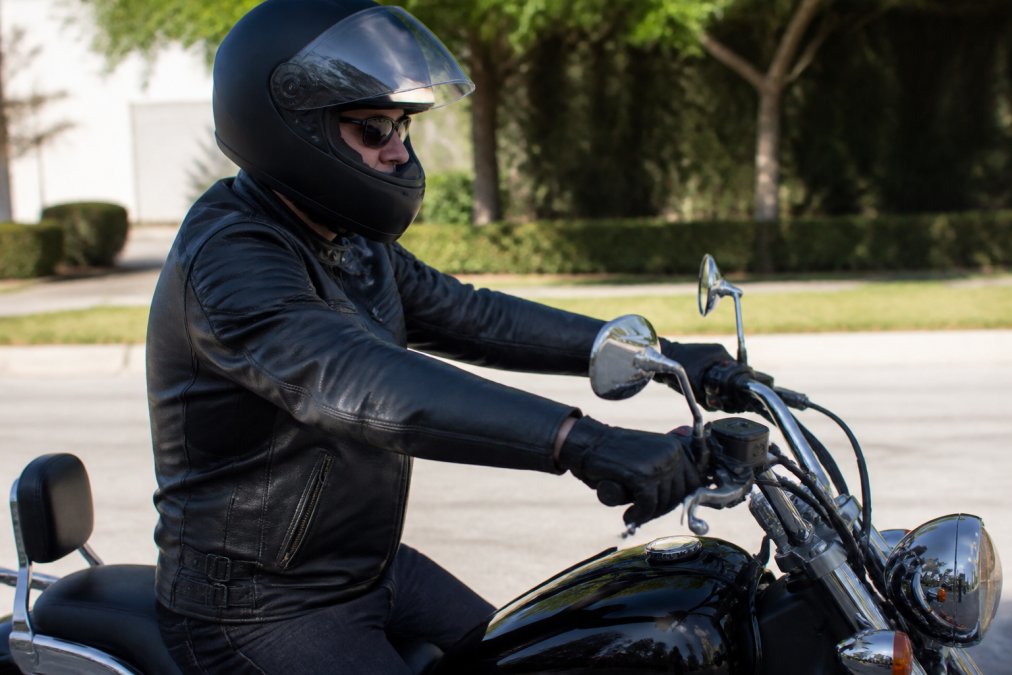
- The reach test: Sit on your bike and reach for the handlebars. The cuffs should stay at your wrists, and your midriff should stay covered.
- The twist test: Cross your arms over your chest. The shoulders should move freely without pulling the whole jacket sideways.
- The pinch test: Grab the fabric at your chest. You should be able to pinch about an inch, no more.
- The movement test: While stationary, move your arms and upper body as you would while riding. The jacket should stay securely in place without excessive shifting or bunching.
Leather vs. Textile: How Fit Differs by Material
Leather and textile gear fit differently, so size each one differently. The biggest mistake riders make is applying leather sizing logic to a textile jacket, or vice versa.
Here’s the quick breakdown:
|
Feature |
Leather |
Textile |
|---|---|---|
|
Initial feel |
Stiff, snug |
Soft, flexible |
|
Break-in time |
Weeks |
None |
|
Stretch |
Slight |
Panels only |
|
Best for |
Commuting, cruising |
Touring, all-weather |
|
Sizing rule |
Snug, size up if between |
True to measurement |
The Break-In Period: What Actually Happens to Each Material
Leather break-in is a molding process, not simply a stretching process. With regular wear, body heat and movement can help leather soften and conform to the wearer. How much a jacket changes depends on the type and thickness of the leather, its construction and how often it is worn.
How Material Choice Changes Your Sizing Decision
- Between two leather sizes? Size up. The smaller size may break in to fit, but if it doesn’t, you’re stuck with a jacket that restricts breathing and shoulder rotation.
- Between two textile sizes? Size down if the larger one feels baggy in the chest, because it will never tighten. Just confirm the armor still sits over your joints before you commit.
- Layering for cold weather? Leather has almost no give, so if you plan to wear a heated liner or heavy base layer, size up one step in leather. Textile with stretch panels can often accommodate a mid-layer without changing size.
- Hot-weather riding? A snug leather jacket over a thin shirt is fine, but a loose-cut textile will flap at highway speed. Look for waist and sleeve adjusters to take up the slack.
A Note on Perforated and Mesh Variants
For general leather care guidance, the FTC’s consumer advice on product care offers tips on maintaining durable goods.
How to Break In a Leather Motorcycle Jacket Without Ruining It
Breaking in a leather motorcycle jacket takes a few weeks of regular wear. Rushing it can crack the finish or stretch it out of shape.
Use this routine:
- Wear it indoors first. Spend an hour a day in the jacket to start the softening process.
- Ride in it often. Body heat and movement do most of the work.
- Condition the leather. Apply a quality leather conditioner every few months to keep it supple.
- Never soak it. Water can stiffen leather and weaken the stitching.
- Store it on a wide hanger. This holds the shoulder shape between rides.
Too Tight or Too Loose? Signs Your Motorcycle Jacket Fit Is Off
You can spot a bad fit by watching for a few clear signs. Check both lists against your own jacket.
Signs it’s too tight:
- You can’t raise your arms past shoulder height
- The zipper strains or won’t close over your chest
- Your arms go numb or tingle on a ride
- Breathing feels restricted when you sit upright
Signs it’s too loose:
- The jacket lifts when you raise your arms
- Armor slides off your shoulders or elbows
- Fabric flaps hard at highway speed
- The midriff shows when you reach for the bars
Body Type Changes Everything, And Most Size Charts Ignore It
Here’s what generic ‘snug but not tight’ advice misses: the same jacket size can be too tight in one zone and too loose in another, depending on your build. Off-the-rack jackets are cut to an average proportion few riders match, so knowing your body type tells you which adjustments to prioritize.
A Quick Self-Check by Build
Before you buy, ask yourself which zone fails first when you try the jacket on:
- Chest or shoulders bind, waist is fine → you need a broader cut or a size up with waist adjustment.
- Waist is baggy, chest is fine → you need a waist cinch or a slimmer cut.
- Sleeves ride up, torso is fine → you need longer sleeves or a gauntlet glove overlap.
- Armor sits low, overall fit is fine → you need adjustable armor pockets or a shorter-torso cut.
Conclusion
Getting the fit right comes down to one rule: snug, not tight. A jacket that stays close to your body keeps its armor in place, blocks wind, and moves with you on every ride.
Frequently Asked Questions
How tight should a motorcycle jacket fit?
A motorcycle jacket should feel snug but never restrictive. You want the leather or textile close enough to your body that CE-rated armor stays over your shoulders, elbows, and back, but loose enough to breathe, twist, and reach the handlebars without pinching. A good test: hug yourself. If the jacket rides up past your midriff or the sleeves pull tight across your back, it is too small. If it shifts when you move, it is too loose.
Does the fit of a motorcycle jacket change after it breaks in?
Yes, especially with leather. A new leather motorcycle jacket may feel stiffer when new and gradually soften and conform to your body with regular wear. It should feel snug from the start, but it should never restrict breathing, arm movement or your ability to comfortably reach the handlebars.
Should a motorcycle jacket be loose enough to layer underneath?
It depends on how you ride. If you ride year-round, size up one step so you can add a thermal liner or base layers without compressing the armor against your body. If you only ride in warm weather, buy your true size for the closest fit. Either way, test the jacket with the layers you actually plan to wear. A jacket that fits perfectly over a t-shirt may feel restrictive over a hoodie.
How should the armor in a motorcycle jacket be positioned?
CE-rated armor should sit directly over the joints it protects. Elbow cups belong centered on your elbows, not sliding down your forearm. Shoulder armor should cover the point of the shoulder, and a back protector should run from between your shoulder blades down to your lower back. Put the jacket on, then move your arms through a full range of motion. If any armor drifts off the joint, the jacket is either the wrong size or the adjustment straps need tightening.