













Table of Contents
- Why New Leather Jackets Feel Stiff (And What Break-In Really Means)
- 1. Wear It Regularly in Short Sessions
- 2. Move and Flex Naturally While Wearing It
- 3. Wear a Light Layer Underneath
- 4. Gently Work Stiff Areas by Hand
- 5. Wear It During Normal Everyday Activities
- 6. Use Leather Conditioner Carefully When Appropriate
- 7. Give Your Leather Jacket Time
- What Not to Do When Breaking In a Leather Jacket
- Genuine Leather Motorcycle Jackets from Jamin Leather®
- Frequently Asked Questions
Last Updated: October 2, 2026
Why New Leather Jackets Feel Stiff (And What Break-In Really Means)
A new genuine leather jacket feels stiff because the hide’s fiber structure is still tightly packed and the natural oils that keep it supple have not yet been worked through the material by movement and body heat.
Most guides get one thing wrong: they treat break-in as a quick fix. It is not. Leather softens the way a good pair of boots does, through many small cycles of flexing and resting, not one aggressive session.
1. Wear It Regularly in Short Sessions
Wear the jacket for 30 to 60 minutes at a time, several days a week, rather than all day once.
A common mistake is wearing a stiff jacket for a full eight-hour day on day one. That does not speed anything up; it just makes the jacket uncomfortable enough that people give up.
As a general rule of thumb, plan on several weeks of regular short sessions before the leather feels noticeably softer. Individual jackets vary by hide, thickness, and finish, so treat any timeline as a rough guide, not a promise.
2. Move and Flex Naturally While Wearing It
Movement helps work the areas of a leather jacket that naturally need the most flexibility.
While wearing the jacket, slowly bend and straighten your arms, roll your shoulders, reach forward, and move through the positions you would normally use while riding. Focus especially on the elbows, shoulders, and upper back rather than trying to stretch the entire jacket at once.
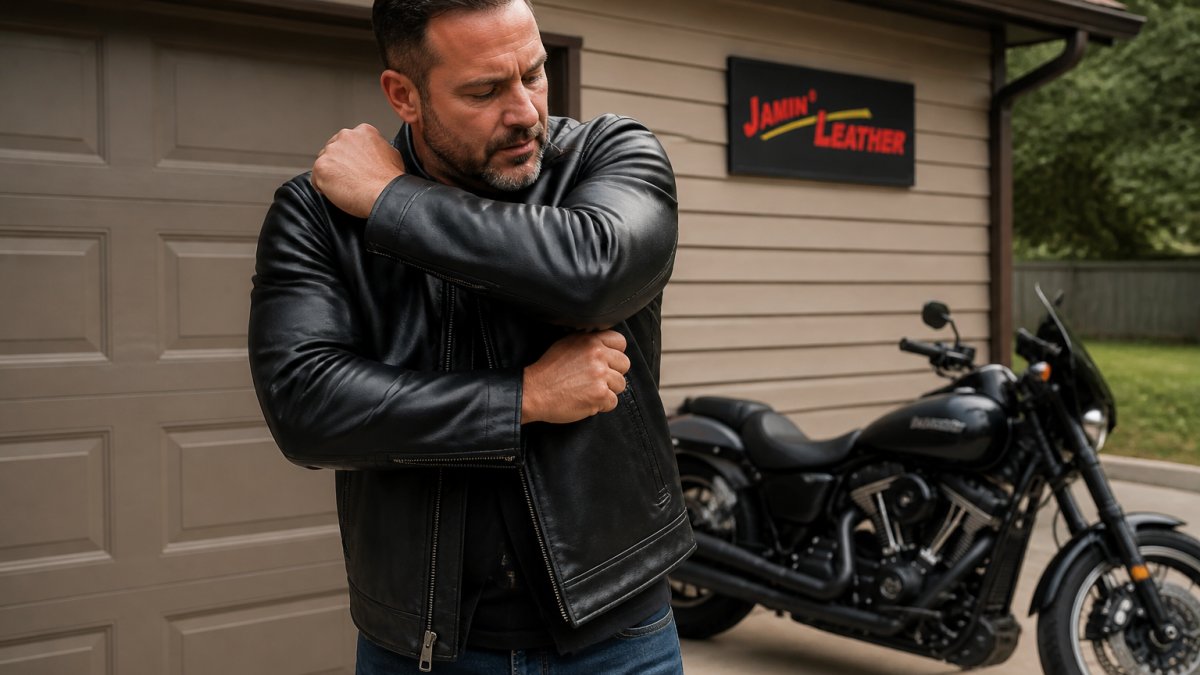
A motorcycle jacket has to work in a riding position, not just standing in front of a mirror. Check shoulder movement first: with the jacket zipped, reach forward as if holding the bars. The shoulders should let you reach without the jacket pulling tight across the back or restricting your arms.
Then check the chest. It should allow a full breath and room for a thin layer, without billowing. Sleeve position matters too: with arms extended to the bars, the cuffs should reach your wrists without riding up your forearms or bunching at the elbow.
If a jacket fails these checks, breaking it in will not fix it. The right move is to compare your measurements against the size chart for that specific jacket and choose a size that fits in the riding position from the start.
3. Wear a Light Layer Underneath
Wearing a lightweight shirt or thin sweatshirt under a properly fitted leather jacket can help the leather gradually adjust to your body as you move. The extra layer adds a little gentle pressure through the shoulders, elbows, and chest without aggressively stretching the leather.
The key is not to overdo it. If adding a normal layer makes the jacket difficult to zip, restricts your breathing, or severely limits your movement, the jacket may be too small rather than simply stiff. Breaking in leather can improve flexibility, but it cannot correct an improper fit.
4. Gently Work Stiff Areas by Hand
Some areas of a new leather jacket may feel noticeably stiffer than others, especially around the elbows, shoulders, collar, and cuffs. You can gently flex and work these areas with your hands when you are not wearing the jacket.
Bend and release the leather naturally rather than twisting, pulling, or trying to force deep creases into it. A few minutes of gentle movement can help encourage the same gradual softening that happens during normal wear.
Avoid aggressive stretching. The goal is to help the leather become more flexible, not permanently distort its shape.
5. Wear It During Normal Everyday Activities
Once the jacket is comfortable enough for longer wear, use it during normal activities instead of trying to create an artificial break-in routine. Walking, sitting, getting on and off the motorcycle, reaching for things, and other everyday movements allow the leather to flex naturally in the places your body actually needs it to.
This gradual process also helps the jacket begin conforming to your individual shape. The elbows, shoulders, back, and collar will typically soften differently based on how you move.
There is no need to artificially heat the leather to speed things up. Hair dryers, space heaters, clothes dryers, and other direct heat sources can dry or damage genuine leather.
6. Use Leather Conditioner Carefully When Appropriate
A leather conditioner may help make some stiff leather more pliable, but it should not be treated as a shortcut for breaking in a new jacket. Different leather types and finishes respond differently to conditioning products.
Before applying anything, check the jacket’s care instructions and make sure the product is intended for that type of leather. Always test a small, hidden area first because conditioner can darken or change the appearance of some leather.
Use conditioner sparingly and follow the product directions. Avoid household oils such as olive oil or baby oil, which are not formulated for leather care.
7. Give Your Leather Jacket Time
Sometimes the best way to break in a stiff leather jacket is simply to give it time. Genuine leather jackets can soften at different rates depending on the type of leather, its thickness, finish, construction, and how frequently the jacket is worn.
A lightweight leather jacket may begin feeling more comfortable fairly quickly, while a heavier motorcycle jacket can take considerably longer. Rather than trying to force the process, wear the jacket regularly and allow it to soften gradually.
As long as the jacket fits correctly from the beginning, you should notice it becoming more flexible and comfortable with continued wear.
What Not to Do When Breaking In a Leather Jacket
Trying to speed up the break-in process can do more harm than good. Avoid soaking a leather jacket in water, putting it in a washing machine or clothes dryer, using a hair dryer or other direct heat, or aggressively pulling and stretching the leather.
Also avoid household oils or products that are not specifically designed for leather. These methods can affect the leather’s finish, color, shape, or condition. A gradual break-in through normal wear is the safer approach.
Genuine Leather Motorcycle Jackets from Jamin Leather®
If you’re shopping for a genuine leather motorcycle jacket, leather type, thickness, construction, and fit can all affect how the jacket feels when new and how it changes with regular wear. Jamin Leather carries several genuine leather riding styles, including cowhide and buffalo leather options.

Ultra Premium Cowhide Leather Vented Café Racer Jacket #M69440GVZK
For a more economical entry into a vented cowhide riding jacket, the Men’s Vented Café Racer Motorcycle Jacket w/Concealed Pocket #M6638VZGK offers top-grain cowhide with 3 front and 2 back zipper vents and a zip-out full sleeve lining. Riders who prefer a softer, heavier-feeling hide can look at buffalo leather styles such as the Men’s Vintage Brown Vented Trucker Jacket #MA66431GN or the Black Cafe Racer Leather Motorcycle Jacket #M570Z.

Women’s Antiqued Gray Leather Motorcycle Jacket #L2402GK
Each listing notes its own leather type, strength rating, and fit guidance, so check the specific product page and size chart before ordering.
Frequently Asked Questions
How long does it take to break in a leather jacket?
Break-in time varies by leather type, thickness, and how often you wear it. A soft lambskin jacket might feel comfortable after a few wears, while a heavy cowhide or buffalo leather motorcycle jacket could take several weeks or even months of regular use. The key is consistent, gradual wear rather than trying to rush the process. Leather jacket break in time depends on the hide, the fit, and how much movement the jacket gets during normal activity. There is no fixed number of hours that works for every jacket.
Does leather conditioner actually help soften a new jacket?
Conditioner can help, but it is not a shortcut. It adds moisture back into the leather, which can make stiff areas more pliable over time. However, conditioner may darken or alter the finish on some leathers, so always spot-test on a hidden area first. Use a product designed for leather, not household oils. Conditioning works best alongside regular wear, not as a replacement for it.
How can I tell if my leather jacket is too small or just stiff?
Signs a leather jacket is too small include: you cannot zip or snap it closed without straining, the shoulders pinch when you reach forward, the sleeves pull up past your wrists when you extend your arms, or you feel restricted in the chest. Stiffness improves with wear; a wrong size does not. If the jacket fits properly but feels rigid, it will soften. If it feels tight in the shoulders, chest, or sleeves even before break-in, sizing up or trying a different cut is the better move. Breaking in leather will not fix a jacket that is the wrong size.
Do motorcycle jackets become more comfortable with wear?
Yes, genuine leather conforms to your body over time. Areas that flex most, like elbows, shoulders, and the collar, soften first. Motorcycle jackets with features like bi-swing shoulders or side zippers can help with mobility from the start, but the leather itself still needs regular wear to loosen up. The process is gradual, and comfort improves with each ride. If a jacket feels restrictive in a riding position even after weeks of wear, the issue is likely fit, not stiffness.
What should I avoid when trying to soften stiff leather?
Do not soak the jacket in water, run it through a washing machine, or put it in a dryer. Avoid hair dryers, space heaters, or any direct heat source. Never aggressively stretch the leather or use household oils like olive oil or baby oil. Skip products not designed for leather. If you use a conditioner, spot-test first. Patience and regular wear are safer than any quick fix.